Karl
Operation NapoleonKarl is Jón’s brother and a key witness to the history of the German aircraft that disappeared on Vatnajökull Glacier. Though he is never encountered directly in the recalled events, his expertise, practical help, and silence shape what the surviving characters can learn. Through Jón’s memories, Karl emerges as both a careful observer of the plane and a loyal participant in Colonel Miller’s decades-long search for it.
Identity and Background
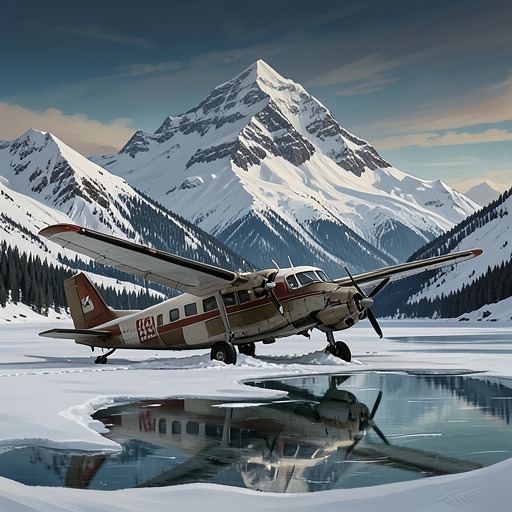
Karl shared Jón’s interest in the Second World War, especially military aircraft. Jón describes the war as a hobby for the brothers: they followed aircraft closely and discussed what they saw. Their knowledge was not merely abstract. When a large plane passed over their farmhouse at night, Karl judged that its size and appearance fit a Junkers Ju 52. At the time, neither brother knew it was German. Jón later explains that Karl recognized the model immediately, drawing on his knowledge of the aircraft used during the war. The plane was the same model as Himmler’s private aircraft, a detail that places the brothers’ local observation within the wider history of the conflict without showing that they knew the plane’s mission.
The account does not give Karl’s age, occupation beyond his connection to the farm, or the circumstances of his death. By the time Kristín questions Jón, Karl has died, and Jón is weighing what his brother would have done before deciding whether to break the promise they had kept. Karl’s character is therefore presented through remembered actions and the objects he left behind, rather than through a scene narrated from his own point of view.
The Plane and Miller’s Search
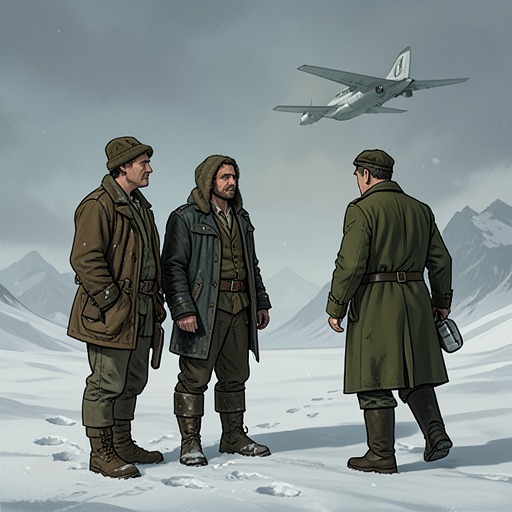
Karl and Jón became important to Colonel Miller when he came to Iceland searching for the missing plane. Miller returned to their farm periodically, presenting the visits as summer holidays, then heading up onto the glacier. The brothers let him stay, sometimes for a week or two. According to Jón, Miller came every three to five years to continue the search, and the last visit was already more than thirty years in the past when Jón told Kristín and Steve about him.
The brothers offered more than hospitality. Their familiarity with the area and their knowledge of aircraft helped Miller, who consulted them during the expedition. The search was arduous: severe weather hampered it twice, and a storm buried tents and other equipment in snow, forcing Miller to abandon the effort. The brothers admired his tireless determination and became friendly with him. Karl’s role in the search belongs to this practical partnership, grounded in local knowledge and a shared effort to find what the glacier had concealed.
The plane itself remained elusive. During one search, the only trace found was the rim of a nose wheel, which Miller immediately took charge of; beyond it, the ice appeared smooth, with no visible evidence of a crash or forced landing. The brothers suggested that drifting snow might already have covered the wreck. Their explanation fits Karl’s repeated experience of searching without success: a glacier can swallow what sinks into it, leaving an apparently empty surface behind.
Loyalty, Memory, and Silence
Jón connects the brothers’ willingness to help Miller with an earlier wartime aircraft accident on Eyjafjallajökull glacier. Information about that American military crash had been limited by a news blackout, though everyone aboard survived and returned safely. When Miller first appeared, Karl and Jón remembered the incident and were eager to assist. Jón later describes their sense of loyalty as perhaps exaggerated, but says they gave Miller their word and kept it. The promise endured beyond Karl’s life and was maintained even after the brothers’ old relationship with Miller had become a matter of distant memory.
That loyalty also explains why Jón had never told anyone what he knew. When Kristín confronts him about helping the American soldiers whose actions left her brother dying on the glacier, Jón is surprised by the accusation. He has kept quiet for years, including after Karl’s death. Kristín’s news puts the old promise under pressure: Jón must consider what Karl would have done in his place. Karl’s influence thus persists as a moral question, not just as a piece of local knowledge.
Photographs, Letters, and the Limits of the Record
Karl left tangible traces of the brothers’ relationship with Miller. He took a photograph of the colonel, which Jón still has. Jón retrieves it from the bottom drawer of a large dresser, among the household’s stored possessions, and also produces Miller’s yellowed thank-you letters. The letters, addressed to Jón, carefully spell both his patronymic and the farm’s name; their Washington postmarks and Abraham Lincoln stamps mark the distance between Miller’s American life and his repeated returns to Iceland. They document the visits and the gratitude that the brothers’ hospitality earned, while the photograph preserves a face from a search otherwise remembered through fragments.
These keepsakes do not disclose the full purpose of Miller’s mission. Years later, the surviving account of the aircraft’s secret is still incomplete: Jón can identify the plane’s likely model from the brothers’ earlier observation, but he does not claim to know its cargo or assignment. The damaged documents later found in a metal case identify Operation Napoleon, yet the surviving evidence does not establish what Karl knew about those papers or the operation. Miller himself says that only a tightly controlled number of people in the army knew what Operation Napoleon entailed, and that even he knew its contents only by hearsay. Karl’s importance lies in what he could reliably contribute—the sighting, the aircraft identification, the search, and the promise—not in an unsupported claim that he understood the secret.
Narrative Role and Significance
Karl is a posthumous character whose presence gathers force through other people’s memories. Jón’s testimony gives the reader access to their shared past, but also makes its limits visible: the account is retrospective, shaped by a promise of silence and by a brother who can no longer clarify what he saw or believed. The photograph and letters corroborate the closeness between Miller and the farm, while the aircraft identification comes from Karl’s remembered expertise. Each kind of evidence answers a different question; none, by itself, resolves the plane’s larger mystery.
The brothers’ searches also make the glacier’s concealment a concrete part of Karl’s story. They repeatedly looked for the aircraft and failed to find it, even though Karl had helped identify its type. The plane’s disappearance is therefore not simply a gap in knowledge but a recurring contrast between what the brothers could recognize and what the ice withheld. Karl’s lasting significance rests in that contrast: he helps make the hidden aircraft imaginable, while his loyalty and silence preserve the uncertainty surrounding it.